

In today’s competitive and fast-changing digital environment, AI tools for marketing have become a fundamental part of every successful strategy. Businesses of all sizes are rapidly integrating AI tools for marketing to automate repetitive tasks, analyse massive datasets, and deliver highly personalized customer experiences. From startups to large enterprises, the adoption of AI tools for marketing is helping brands improve efficiency, reduce costs, and increase ROI. Whether it’s email campaigns, content creation, social media management, or customer segmentation, AI tools for marketing provide unmatched capabilities that traditional methods simply cannot compete with. As consumer behaviour continues to evolve, relying on AI tools for marketing ensures that businesses stay relevant, agile, and data-driven in their decision-making processes.
One of the biggest advantages of using AI tools for marketing is their ability to transform raw data into actionable insights. These AI tools for marketing can track user behaviour, predict trends, and optimize campaigns in real time, allowing marketers to make smarter decisions faster. For beginners and freelancers, AI tools for marketing simplify complex processes like SEO optimization, ad targeting, and performance tracking. At the same time, businesses can use advanced AI tools for marketing for customer journey mapping, chatbots, predictive analytics, and automated content generation. By leveraging AI tools for marketing, companies can create more engaging and relevant content, improve customer satisfaction, and ultimately drive higher conversions. The scalability of AI tools for marketing also means that as your business grows, your marketing capabilities can expand without significantly increasing workload.
Looking ahead, the future of AI tools for marketing is incredibly promising, with continuous advancements shaping how brands interact with their audiences. Emerging technologies like machine learning, natural language processing, and generative AI are making AI tools for marketing even more powerful and accessible. Businesses that invest early in AI tools for marketing will gain a significant competitive advantage, as these tools enable hyper-personalization, voice search optimization, and predictive customer engagement. Additionally, AI tools for marketing are expected to play a key role in areas like video marketing, influencer analysis, and real-time customer support. As digital marketing continues to evolve, mastering AI tools for marketing is no longer just an option—it is a necessity for anyone looking to succeed in the modern marketing landscape.
What Are AI Tools for Marketing?

AI tools for marketing are advanced software platforms that use artificial intelligence technologies such as machine learning, natural language processing, and predictive analytics to automate and enhance marketing activities. These AI tools for marketing are designed to help businesses streamline their processes, reduce manual work, and make smarter, data-driven decisions. By using AI tools for marketing, companies can analyse customer data more effectively and create targeted strategies that improve overall performance.
One of the key strengths of AI tools for marketing is their ability to process and analyse large amounts of data in a very short time. These tools can identify patterns, trends, and customer behaviours that would be difficult for humans to detect manually. With AI tools for marketing, businesses can predict customer needs, understand buying behaviour, and optimize campaigns for better results. This level of insight allows marketers to make more accurate and impactful decisions.
AI tools for marketing also play a crucial role in personalization and automation. They help marketers deliver personalized content, product recommendations, and messages based on individual user preferences. At the same time, AI tools for marketing can automate repetitive tasks such as email campaigns, social media posting, and ad management. This not only saves time but also ensures consistency and efficiency in marketing efforts.
In simple terms, AI tools for marketing make marketing smarter, faster, and more effective. They empower businesses to improve campaign performance, increase engagement, and boost return on investment. As digital marketing continues to evolve, adopting AI tools for marketing is becoming essential for staying competitive and achieving long-term success.
Why AI Tools for Marketing Are Important in 2026
The importance of AI tools for marketing has increased dramatically in 2026 as businesses operate in a highly competitive and rapidly evolving digital environment. Consumers today expect instant responses, personalized experiences, and highly relevant content at every stage of their journey. This shift in expectations has made AI tools for marketing a critical component of modern marketing strategies. Businesses that fail to adopt AI tools for marketing risk falling behind competitors who are already leveraging automation and data-driven insights to engage customers more effectively. By using AI tools for marketing, companies can stay agile, adapt quickly to market changes, and consistently deliver value to their audience.
One of the most significant advantages of AI tools for marketing is the ability to enable data-driven decision-making. In today’s digital landscape, businesses generate massive amounts of data from websites, social media, email campaigns, and customer interactions. AI tools for marketing can analyse this data in real time, uncover patterns, and provide actionable insights that help marketers make smarter decisions. With AI tools for marketing, businesses can identify what works and what doesn’t, optimize campaigns instantly, and improve overall performance. This level of intelligence allows companies to reduce risks, eliminate guesswork, and focus on strategies that deliver measurable results.
Another key reason why AI tools for marketing are essential in 2026 is their ability to deliver personalization at scale. Modern customers expect brands to understand their preferences and provide tailored experiences. AI tools for marketing make this possible by analysing user behaviour, purchase history, and engagement patterns to create highly personalized content, emails, and advertisements. By using AI tools for marketing, businesses can send the right message to the right audience at the right time, increasing engagement and building stronger relationships. This level of personalization not only enhances customer satisfaction but also significantly boosts conversion rates and brand loyalty.
In addition to personalization, AI tools for marketing offer unmatched efficiency by automating repetitive and time-consuming tasks. Tasks such as email marketing, social media scheduling, ad optimization, and customer support can be handled seamlessly using AI tools for marketing. This automation saves valuable time and reduces operational costs, allowing marketing teams to focus on strategic planning and creative execution. Moreover, campaigns powered by AI tools for marketing are continuously optimized based on real-time data, leading to better performance and higher return on investment. As a result, businesses can achieve more with fewer resources while maintaining consistency and quality.
Finally, AI tools for marketing play a crucial role in improving overall ROI and driving sustainable growth. By combining automation, personalization, and data analysis, AI tools for marketing help businesses maximize the effectiveness of their campaigns. Companies that invest in AI tools for marketing can achieve higher engagement, better customer retention, and increased revenue. As digital marketing continues to evolve, the role of AI tools for marketing will only become more significant. In 2026 and beyond, embracing AI tools for marketing is not just a smart decision—it is a necessity for any business aiming to succeed in the modern marketplace.
Types of AI Tools for Marketing
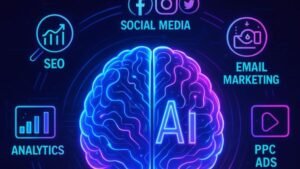
There are various categories of AI tools for marketing, each designed to solve specific challenges and improve different aspects of marketing performance. Understanding these categories of AI tools for marketing helps businesses choose the right solutions based on their goals and strategy.
1. Content Creation Tools
Content creation AI tools for marketing are widely used to generate high-quality blog posts, ad copies, product descriptions, and social media content in a fraction of the time. These AI tools for marketing use natural language processing to understand context, tone, and audience preferences, allowing marketers to create engaging and relevant content consistently. By using content-focused AI tools for marketing, businesses can scale their content production without compromising quality. Additionally, these AI tools for marketing help maintain consistency in brand voice, improve creativity, and reduce the time spent on manual writing tasks, making them essential for modern content strategies.
2. SEO Optimization Tools
SEO-focused AI tools for marketing play a crucial role in improving website visibility and search engine rankings. These AI tools for marketing assist with keyword research, competitor analysis, on-page optimization, and content suggestions based on current search trends. By leveraging SEO AI tools for marketing, businesses can identify high-performing keywords, optimize their content structure, and improve their chances of ranking higher on search engines. These AI tools for marketing also provide real-time insights and recommendations, helping marketers continuously refine their SEO strategies and stay ahead of algorithm updates.
3. Social Media Management Tools
Social media AI tools for marketing help businesses manage multiple platforms efficiently by automating tasks such as content scheduling, posting, and performance tracking. These AI tools for marketing analyse audience engagement, suggest optimal posting times, and even recommend content ideas based on trends. By using social media AI tools for marketing, marketers can maintain a consistent online presence while saving time and effort. Furthermore, these AI tools for marketing provide detailed analytics that help businesses understand what type of content performs best, enabling them to optimize their social media strategies for better engagement and growth.
4. Email Marketing Tools
Email marketing AI tools for marketing are designed to enhance campaign effectiveness through personalization and automation. These AI tools for marketing analyse user behaviour, preferences, and past interactions to create highly targeted email campaigns. By using email-based AI tools for marketing, businesses can send personalized messages, optimize subject lines, and determine the best time to send emails for higher open and click-through rates. These AI tools for marketing also automate follow-ups and segmentation, ensuring that the right message reaches the right audience, ultimately improving conversion rates and customer retention.
5. Chatbots and Customer Support
Chatbots are one of the most impactful AI tools for marketing, providing instant responses and 24/7 customer support. These AI tools for marketing use artificial intelligence to understand customer queries and deliver accurate, real-time solutions. By integrating chatbot-based AI tools for marketing, businesses can enhance customer experience, reduce response time, and handle multiple inquiries simultaneously. These AI tools for marketing also collect valuable customer data, which can be used to improve marketing strategies and personalize future interactions, making them a powerful tool for both support and engagement.
6. Analytics and Insights Tools
Analytics-focused AI tools for marketing are essential for tracking performance and making informed decisions. These AI tools for marketing collect and analyse data from various channels, providing insights into customer behaviour, campaign effectiveness, and market trends. By using analytics AI tools for marketing, businesses can measure key performance indicators, identify areas for improvement, and predict future outcomes. These AI tools for marketing enable marketers to optimize their strategies continuously, ensuring better results and higher ROI through data-driven decision-making.
Best AI Tools for Marketing in 2026
Let’s explore some of the most powerful AI tools for marketing available in 2026. These AI tools for marketing are transforming how businesses create content, optimize campaigns, and engage with customers, making them essential for marketers who want to stay ahead of the competition.
1. ChatGPT
One of the most widely used AI tools for marketing, ChatGPT is known for its ability to generate high-quality content, brainstorm ideas, and automate communication. Businesses use this AI tools for marketing solution for blog writing, email drafting, ad copy creation, and even customer support. With its advanced natural language capabilities, this AI tools for marketing platform helps marketers save time while producing engaging and relevant content. As one of the leading AI tools for marketing, it is ideal for both beginners and professionals looking to scale their content efforts.
2. Jasper AI
Jasper AI is another powerful option among AI tools for marketing, especially for creating marketing copy and long-form blog posts. This AI tools for marketing platform is designed to generate persuasive and conversion-focused content quickly. Marketers rely on this AI tools for marketing tool to maintain consistency in tone and messaging across different campaigns. With its templates and automation features, Jasper AI stands out as one of the most efficient AI tools for marketing for content-heavy strategies.
3. Surfer SEO
Surfer SEO is a must-have among AI tools for marketing for businesses focused on improving search engine rankings. This AI tools for marketing tool provides data-driven recommendations for keyword usage, content structure, and on-page SEO. By using this AI tools for marketing platform, marketers can optimize their content to rank higher on search engines and attract more organic traffic. It is one of the most effective AI tools for marketing for SEO professionals and content creators.
4. Canva AI
Canva AI has become one of the most popular AI tools for marketing for creating visual content. This AI tools for marketing platform allows users to design social media posts, presentations, and marketing creatives بسهولة using AI-powered features. With tools like text-to-image and automated design suggestions, this AI tools for marketing solution helps businesses produce high-quality visuals without requiring advanced design skills. It is an essential AI tools for marketing choice for branding and social media marketing.
5. HubSpot AI
HubSpot AI is a comprehensive solution among AI tools for marketing, offering features for CRM, email marketing, and automation. This AI tools for marketing platform helps businesses manage customer relationships, personalize campaigns, and automate workflows efficiently. By using HubSpot AI, companies can streamline their marketing processes and improve customer engagement. It is one of the most versatile AI tools for marketing for businesses looking for an all-in-one platform.
6. Copy.ai
Copy.ai is another highly effective option among AI tools for marketing for generating marketing copy quickly and efficiently. This AI tools for marketing tool is ideal for creating ad copy, product descriptions, and social media captions. Marketers use this AI tools for marketing platform to speed up content production while maintaining quality and creativity. As one of the fastest-growing AI tools for marketing, Copy.ai is perfect for businesses aiming to scale their marketing efforts.
Using these AI tools for marketing can significantly improve productivity, enhance creativity, and deliver better results. By integrating the right AI tools for marketing into your strategy, you can stay competitive and achieve higher efficiency in 2026.
How to Use AI Tools for Marketing Effectively
Simply using AI tools for marketing is not enough—you need a clear strategy to get the best results. Businesses that succeed with AI tools for marketing focus on planning, execution, and continuous improvement rather than just relying on automation. By using AI tools for marketing the right way, you can maximize efficiency, improve campaign performance, and achieve long-term growth in a competitive digital landscape.
1. Define Your Goals
The first step to using AI tools for marketing effectively is to clearly define your goals. Before implementing any AI tools for marketing, you should identify what you want to achieve, such as increasing website traffic, generating leads, improving conversions, or building brand awareness. When your goals are clear, it becomes easier to select and use AI tools for marketing in a focused and strategic way. Without proper goals, even the best AI tools for marketing may not deliver the desired results, as there is no clear direction for optimization and measurement.
2. Choose the Right Tools
Selecting the right AI tools for marketing is crucial for success. Not all AI tools for marketing serve the same purpose, so it is important to choose tools that align with your specific objectives. For example, if your goal is content creation, you should focus on content-based AI tools for marketing, while SEO-focused goals require optimization tools. By carefully choosing the right AI tools for marketing, businesses can avoid unnecessary complexity and ensure better integration into their existing workflows. The right selection of AI tools for marketing can significantly enhance productivity and overall marketing effectiveness.
3. Combine Human Creativity with AI
While AI tools for marketing are powerful, they work best when combined with human creativity and strategic thinking. AI tools for marketing can generate ideas, automate tasks, and analyse data, but human input is essential to add originality, emotional connection, and brand personality. Marketers should use AI tools for marketing as a support system rather than a complete replacement. By blending human creativity with AI tools for marketing, businesses can create unique and engaging campaigns that stand out in the market.
4. Optimize Continuously
Continuous optimization is key to getting the most out of AI tools for marketing. One of the biggest advantages of AI tools for marketing is their ability to provide real-time data and insights. Businesses should regularly analyse this data to identify what is working and what needs improvement. By continuously refining strategies using insights from AI tools for marketing, marketers can improve campaign performance, increase ROI, and stay ahead of competitors. Consistent optimization ensures that AI tools for marketing deliver maximum value over time.
Benefits of AI Tools for Marketing
The advantages of using AI tools for marketing are immense, especially in today’s fast-paced digital world where efficiency and personalization are key to success. Businesses that adopt AI tools for marketing can streamline operations, reduce manual effort, and improve overall campaign performance. By integrating AI tools for marketing into their strategies, companies can achieve better results while saving time and resources.
1. Automation
One of the biggest benefits of AI tools for marketing is automation. These AI tools for marketing can handle repetitive tasks such as social media posting, email campaigns, data entry, and customer segmentation. By automating these processes, AI tools for marketing free up valuable time for marketers to focus on strategy and creativity. Automation through AI tools for marketing also ensures consistency and efficiency, reducing delays and improving workflow management across campaigns.
2. Accuracy
Accuracy is another major advantage of AI tools for marketing. Human errors can negatively impact marketing performance, but AI tools for marketing minimize these risks by using data-driven algorithms and precise analysis. These AI tools for marketing can process large volumes of data with high accuracy, ensuring better targeting and decision-making. By relying on AI tools for marketing, businesses can improve the quality of their campaigns and achieve more reliable results.
3. Scalability
Scalability is a key reason why businesses invest in AI tools for marketing. As a company grows, managing campaigns manually becomes difficult, but AI tools for marketing make it easy to scale operations without increasing workload. These AI tools for marketing allow businesses to handle larger audiences, multiple campaigns, and diverse channels efficiently. With the help of AI tools for marketing, companies can expand their reach while maintaining performance and consistency.
4. Better Customer Experience
Providing a better customer experience is another important benefit of AI tools for marketing. These AI tools for marketing enable personalized communication, instant responses, and relevant content delivery based on user behavior. By using AI tools for marketing, businesses can understand customer needs and provide tailored solutions that improve satisfaction and engagement. A strong customer experience powered by AI tools for marketing leads to higher loyalty and long-term relationships.
5. Competitive Advantage
Finally, AI tools for marketing give businesses a strong competitive advantage. Companies that leverage advanced AI tools for marketing can respond faster to market changes, optimize campaigns in real time, and outperform competitors who rely on traditional methods. By adopting AI tools for marketing, businesses can stay ahead in the industry, innovate their strategies, and achieve sustainable growth. In today’s competitive landscape, using AI tools for marketing is essential for long-term success.
Challenges of AI Tools for Marketing
Despite the many advantages, AI tools for marketing also come with certain challenges that businesses must understand and manage effectively. While AI tools for marketing can significantly improve efficiency and performance, improper use or lack of planning can lead to issues that impact results. Understanding these challenges helps businesses use AI tools for marketing in a more balanced and strategic way.
1. High Initial Cost
One of the biggest challenges of AI tools for marketing is the high initial cost involved in implementing advanced solutions. Many premium AI tools for marketing require subscriptions, integrations, and sometimes even infrastructure upgrades, which can be expensive for small businesses and startups. Investing in AI tools for marketing may also involve training teams and hiring skilled professionals, adding to the overall cost. Although AI tools for marketing provide long-term benefits, the upfront investment can be a barrier for businesses with limited budgets, making it important to carefully evaluate the return on investment before adopting these tools.
2. Learning Curve
Another major challenge of AI tools for marketing is the learning curve associated with using them effectively. While many AI tools for marketing are designed to be user-friendly, understanding their full capabilities requires time and effort. Marketers need to learn how to interpret data, configure automation, and optimize campaigns using AI tools for marketing. Without proper knowledge, businesses may not fully utilize the potential of AI tools for marketing, leading to suboptimal results. Continuous learning and training are essential to ensure that teams can use AI tools for marketing efficiently and strategically.
3. Over-Reliance on AI
Over-reliance on AI tools for marketing can also become a significant drawback. While AI tools for marketing are powerful, depending too much on them can reduce human creativity and originality. Marketing is not just about data and automation; it also requires emotional connection, storytelling, and brand identity. If businesses rely solely on AI tools for marketing, their content may become repetitive or lack a personal touch. Therefore, it is important to use AI tools for marketing as a support system while maintaining a balance between automation and human creativity.
4. Data Privacy Concerns
Data privacy is another critical challenge when using AI tools for marketing. These AI tools for marketing rely heavily on customer data to provide insights, personalization, and automation. However, handling this data responsibly is essential to maintain trust and comply with regulations. Improper use of AI tools for marketing can lead to data breaches, misuse of information, or legal issues. Businesses must ensure that their AI tools for marketing follow strict data protection policies and comply with privacy laws. By managing data responsibly, companies can safely leverage AI tools for marketing while maintaining customer trust and credibility.
Future of AI Tools for Marketing
The future of AI tools for marketing is incredibly promising as technology continues to evolve at a rapid pace. Businesses are increasingly relying on AI tools for marketing to stay competitive, deliver better customer experiences, and make smarter decisions. As innovation grows, AI tools for marketing will become more advanced, accessible, and deeply integrated into every aspect of digital marketing. Companies that embrace AI tools for marketing early will be better positioned to adapt to changing trends and gain a strong competitive edge.
1. Voice Search Optimization
One of the most important future trends in AI tools for marketing is voice search optimization. With the rise of voice assistants and smart devices, more users are searching using voice commands instead of typing. AI tools for marketing will play a key role in helping businesses optimize their content for voice queries by understanding natural language and user intent. These AI tools for marketing will allow marketers to create conversational content, improve search visibility, and reach audiences in new ways. As voice search continues to grow, AI tools for marketing will become essential for capturing this expanding segment of users.
2. Hyper-Personalization
Hyper-personalization is another major development in AI tools for marketing. While personalization already exists, future AI tools for marketing will take it to a much deeper level by analysing real-time data, behaviour patterns, and user preferences. These AI tools for marketing will enable businesses to deliver highly customized experiences, including personalized content, product recommendations, and targeted messaging. By using advanced AI tools for marketing, brands can build stronger connections with their audience and significantly improve engagement and conversion rates.
3. Predictive Marketing
Predictive marketing is set to become a core function of AI tools for marketing in the future. These AI tools for marketing will use historical data, machine learning, and analytics to predict customer behaviour and market trends before they happen. By leveraging predictive capabilities, AI tools for marketing will help businesses make proactive decisions rather than reactive ones. This means companies can plan campaigns more effectively, allocate resources efficiently, and stay ahead of competitors by anticipating customer needs and market changes.
4. AI Video Content Creation
Video marketing is rapidly growing, and AI tools for marketing will play a major role in shaping its future. Advanced AI tools for marketing will enable businesses to create high-quality videos automatically, including editing, scripting, voiceovers, and visual effects. These AI tools for marketing will make video production faster, more affordable, and accessible to businesses of all sizes. As video continues to dominate digital platforms, AI tools for marketing will help brands produce engaging visual content that captures attention and drives results.
Businesses that adopt AI tools for marketing early will gain a significant advantage in the evolving digital landscape. By leveraging the power of AI tools for marketing, companies can innovate faster, connect with their audience more effectively, and achieve long-term success.
Tips to Maximize Results with AI Tools for Marketing
To get the best results from AI tools for marketing, it’s important to go beyond basic usage and adopt a strategic approach. Simply using AI tools for marketing without proper planning may not deliver the expected outcomes. Businesses that maximize the value of AI tools for marketing focus on integration, continuous improvement, and data-driven decision-making. By following the right practices, AI tools for marketing can significantly boost performance, efficiency, and ROI.
1. Use Multiple Tools Together
One of the most effective ways to maximize results with AI tools for marketing is to use multiple tools together. Different AI tools for marketing are designed for specific purposes such as content creation, SEO, analytics, and automation. By combining these AI tools for marketing, businesses can create a more powerful and efficient marketing system. For example, using content generation AI tools for marketing along with SEO and analytics tools ensures that your content is not only high-quality but also optimized for performance. Integrating multiple AI tools for marketing allows for better workflow, improved accuracy, and stronger overall results.
2. Keep Updating Your Strategies
The digital landscape is constantly evolving, and so are AI tools for marketing. To stay competitive, businesses must regularly update their strategies based on new trends and insights. AI tools for marketing provide valuable data and recommendations that can help refine campaigns over time. By continuously improving your approach using AI tools for marketing, you can adapt to market changes, optimize performance, and stay ahead of competitors. Regular updates ensure that your AI tools for marketing are always aligned with your business goals and audience needs.
3. Monitor Performance Regularly
Monitoring performance is essential when using AI tools for marketing. These AI tools for marketing offer real-time analytics and insights that help track the success of your campaigns. By regularly analysing data from AI tools for marketing, businesses can identify what is working and what needs improvement. This allows marketers to make quick adjustments and optimize strategies for better results. Consistent monitoring ensures that AI tools for marketing are delivering maximum value and contributing to overall business growth.
4. Focus on User Intent
Understanding user intent is crucial for maximizing the effectiveness of AI tools for marketing. These AI tools for marketing are designed to analyse customer behaviour and preferences, helping businesses create more relevant and targeted content. By focusing on user intent, AI tools for marketing can deliver personalized experiences that improve engagement and conversions. When businesses align their strategies with user needs using AI tools for marketing, they can build stronger relationships and achieve better marketing outcomes.
5. Combine SEO with AI
Combining SEO with AI tools for marketing is a powerful strategy for driving organic traffic and improving visibility. AI tools for marketing can enhance keyword research, content optimization, and performance tracking, making SEO efforts more effective. By integrating SEO practices with AI tools for marketing, businesses can create content that ranks higher on search engines and reaches the right audience. This combination ensures long-term growth and sustainable results, making AI tools for marketing an essential part of any successful digital marketing strategy.
AI Tools for Marketing for Beginners
If you are new to digital marketing, starting with AI tools for marketing can feel overwhelming, but the key is to begin simple and build gradually. Many beginner-friendly AI tools for marketing are designed with easy interfaces and guided features, making them perfect for those who are just getting started. By using basic AI tools for marketing, you can understand how automation, content creation, and analytics work without getting confused by complex features. This step-by-step approach helps you build confidence while learning how to effectively use AI tools for marketing in real-world scenarios.
For beginners, content generators are among the most useful AI tools for marketing. These AI tools for marketing help you create blog posts, social media captions, and ad copy quickly without needing advanced writing skills. Similarly, social media schedulers are simple yet powerful AI tools for marketing that allow you to plan, automate, and manage posts across different platforms. Basic SEO tools are also essential AI tools for marketing, as they help you find keywords, optimize content, and improve your website’s visibility on search engines. Starting with these foundational AI tools for marketing allows beginners to handle essential marketing tasks efficiently.
As you gain experience, you can gradually move to more advanced AI tools for marketing that offer deeper insights and automation capabilities. These advanced AI tools for marketing include predictive analytics, customer segmentation, advanced SEO optimization, and marketing automation platforms. By progressing step by step, beginners can avoid confusion and fully understand how to leverage AI tools for marketing for better results. With consistent practice and learning, using AI tools for marketing becomes easier, helping you grow your skills and achieve better marketing outcomes over time.
AI Tools for Marketing in Different Industries
Different industries use AI tools for marketing in unique and highly effective ways to improve performance, enhance customer experience, and drive better results. The flexibility and power of AI tools for marketing allow businesses across sectors to automate processes, personalize communication, and make data-driven decisions. As the adoption of AI tools for marketing continues to grow, each industry is finding innovative ways to leverage these tools for maximum impact.
E-commerce
In the e-commerce industry, AI tools for marketing play a crucial role in driving sales and improving customer experience. These AI tools for marketing analyze user behaviour, browsing history, and purchase patterns to provide personalized product recommendations. By using AI tools for marketing, e-commerce businesses can create targeted ads, optimize pricing strategies, and improve inventory management. Additionally, AI tools for marketing help automate email campaigns, retarget customers, and enhance the overall shopping experience. With the help of AI tools for marketing, e-commerce brands can increase conversions, boost customer retention, and maximize revenue growth in a highly competitive market.
Real Estate
The real estate industry is also benefiting significantly from AI tools for marketing. These AI tools for marketing are used for lead generation, customer segmentation, and automated follow-ups. By leveraging AI tools for marketing, real estate businesses can identify potential buyers, track user interest, and send personalized property recommendations. Chatbots powered by AI tools for marketing provide instant responses to inquiries, improving customer engagement and satisfaction. Furthermore, AI tools for marketing help analyse market trends, property demand, and pricing strategies, enabling real estate professionals to make smarter decisions and close deals faster.
Healthcare
In the healthcare sector, AI tools for marketing are transforming how organizations engage with patients and deliver information. These AI tools for marketing are used for patient communication, appointment reminders, and personalized health content delivery. By using AI tools for marketing, healthcare providers can improve patient engagement and ensure timely communication. Additionally, AI tools for marketing help analyse patient data to deliver relevant information and improve overall service quality. With the support of AI tools for marketing, healthcare organizations can build trust, enhance patient experience, and streamline their communication processes effectively.
Education
The education sector is increasingly adopting AI tools for marketing to improve content delivery and student interaction. These AI tools for marketing help institutions create personalized learning experiences, automate communication, and engage students more effectively. By using AI tools for marketing, educational institutions can send targeted messages, recommend courses, and track student behaviour. These AI tools for marketing also support content creation, social media marketing, and enrolment campaigns. With the help of AI tools for marketing, educational organizations can attract more students, improve engagement, and deliver a more customized learning experience in a competitive environment.
Overall, AI tools for marketing are transforming industries by enabling smarter strategies, better communication, and improved outcomes. Businesses that effectively use AI tools for marketing across different sectors can achieve higher efficiency, stronger customer relationships, and long-term success.
Common Mistakes to Avoid
When using AI tools for marketing, many businesses focus only on automation and speed while overlooking strategy and balance. Although AI tools for marketing can significantly improve efficiency and results, improper usage can lead to poor outcomes and missed opportunities. To get the best results from AI tools for marketing, it’s important to understand and avoid some common mistakes that can limit their effectiveness.
1. Ignoring Human Creativity
One of the biggest mistakes when using AI tools for marketing is ignoring human creativity. While AI tools for marketing can generate content, ideas, and data insights, they lack emotional intelligence and originality. Relying only on AI tools for marketing can make your content feel generic and less engaging. Human creativity is essential to add storytelling, brand voice, and uniqueness. The best approach is to combine human input with AI tools for marketing to create content that is both data-driven and emotionally appealing.
2. Using Too Many Tools at Once
Another common mistake is using too many AI tools for marketing at the same time. While there are many powerful AI tools for marketing available, using too many can create confusion, inefficiency, and unnecessary complexity. Managing multiple AI tools for marketing without a clear strategy can lead to inconsistent results and wasted resources. It is better to choose a few essential AI tools for marketing that align with your goals and use them effectively rather than trying to use everything at once.
3. Not Analysing Results
Failing to analyse results is a critical mistake when using AI tools for marketing. These AI tools for marketing provide valuable data and insights, but if you don’t review and act on this data, you miss out on optimization opportunities. By regularly analyzing performance metrics from AI tools for marketing, businesses can understand what works and what doesn’t. Without proper analysis, AI tools for marketing cannot deliver their full potential, and campaigns may not achieve desired results.
4. Over-Automating Everything
Over-automating is another challenge when working with AI tools for marketing. While automation is a key benefit of AI tools for marketing, excessive automation can make interactions feel robotic and impersonal. Customers still value human connection, and relying entirely on AI tools for marketing can reduce authenticity. It is important to strike a balance by using AI tools for marketing for efficiency while maintaining a human touch in communication and engagement. This ensures better customer relationships and more meaningful interactions.
Conclusion
AI tools for marketing are transforming the way businesses operate in today’s digital landscape. From automating repetitive tasks to delivering highly personalized customer experiences, AI tools for marketing provide powerful solutions that improve efficiency and performance. As competition continues to grow, businesses that adopt AI tools for marketing can streamline their processes, reduce manual effort, and make smarter, data-driven decisions. The impact of AI tools for marketing is not just short-term—it is shaping the future of how brands connect with their audience.
By understanding and implementing AI tools for marketing, businesses can unlock new opportunities for growth and innovation. These AI tools for marketing help marketers analyse data, optimize campaigns, and deliver targeted content that drives better engagement and conversions. Whether it’s content creation, SEO, social media, or customer support, AI tools for marketing enhance every aspect of digital marketing. Companies that effectively use AI tools for marketing can stay ahead of trends, respond quickly to changes, and build stronger relationships with their customers.
Whether you’re a beginner or an experienced marketer, now is the perfect time to start leveraging AI tools for marketing. With continuous advancements in technology, AI tools for marketing are becoming more accessible and easier to use. By integrating AI tools for marketing into your strategy, you can improve productivity, increase ROI, and achieve long-term success. Embracing AI tools for marketing today will position your business for sustained growth and a competitive advantage in the evolving digital world.
AUTHOR : DEVIKA V P